Ceiling Fan Size Calculator
Enter the room and its ceiling height, and get the blade span to shop for, the downrod to hang it on and how high the blades will sit.
By Nora Callahan · Updated
Your room
Fan to look for
A 44 in fan
A 12 × 15 ft room (180 sq ft) takes a fan with a 44 in blade span. Under a 9 ft ceiling, the short rod that comes with the fan puts the blades about 7 ft 8 in above the floor.
Blade spans
- 42 inDoesn't fittoo small for the room
- 44 inFitsthe size for this room
- 48 inTighta little large for the room
- 52 inTighta little large for the room
- 54 inTighta little large for the room
- 56 inDoesn't fittoo large for the room
Fits: the span for the room's area. Tight: a little larger, but it still suits the room. Blade tips stay 18 in from the walls.
The blade height is an estimate: fans differ in how far their blades sit below the ceiling, so check the model's measurements before you buy the downrod. How we calculate

The short answer
Size the fan by the room’s floor area: 29 to 36 in up to 75 sq ft, 36 to 42 in up to 144 sq ft, 44 in up to 225 sq ft and 50 to 54 in up to 400 sq ft. Hang it so the blades sit at least 7 ft above the floor, 8 to 9 ft if the ceiling allows, and keep the blade tips 18 in from the walls. For the downrod, subtract 9 ft from the ceiling height: 36 in under a 12 ft ceiling.
How to measure
- Measure the room wall to wall in both directions, so the calculator can work out the floor area and check the shorter side.
- Measure the ceiling height where the fan will hang, from the floor to the ceiling.
- Note any light kit: it hangs below the blades, so the fan needs a shorter downrod.
- On the product page, look for the blade span (the diameter the blades sweep) and the height from the ceiling to the blades.
How to use the calculator
- Enter the room’s width and length and the ceiling height.
- Tick the light kit box if the fan has one.
- Read the result: the blade span to look for, the mount or downrod, about how high the blades will sit and how the common blade spans fit your room.
- Save or share it. Copy link keeps your numbers in the address.
How we calculate
Your fan’s own instructions come first. The spans, heights and clearances below cover the rest.
- Blade span: by floor area, 29 to 36 in up to 75 sq ft, 36 to 42 in up to 144 sq ft, 44 in up to 225 sq ft and 50 to 54 in up to 400 sq ft. Over 400 sq ft, 54 to 72 in or more than one fan. A room on a band’s edge belongs to the smaller band. A span Fits inside the room’s band and is Tight when it’s larger but still within a wider range for the same area: 44 to 54 in for rooms over 144 sq ft and up to 225 sq ft, for example.
- Walls: the blade tips stay at least 18 in from every wall, so no fan wider than the room’s shorter side minus twice that.
- Downrod: the ceiling height minus 9 ft, which puts the blades about 8 ft above the floor, allowing about 12 in for the fan itself. With a light kit, 12 in shorter. Downrods come in 6 in steps, so we round down, up to 120 in. When the result is shorter than one step, the short rod that comes with the fan does the job.
- Low ceilings: when even the short rod would bring the blades below 7 ft, the answer is a hugger fan, mounted flush, whose blades sit no more than 10 in below the ceiling, or less under a very low ceiling.
- Two fans: in a room longer than 18 ft or larger than 400 sq ft, we size each fan for half the floor area.
Worked examples
Worked example
A 12 × 15 ft bedroom with a 9 ft ceiling
What we know
- Room: 12 × 15 ft
- Ceiling: 9 ft
- Light kit: no
How it works out
- Floor area: 12 × 15 ft = 180 sq ft.
- Blade span for rooms up to 225 sq ft: 44 in.
- Walls: the blade tips need 18 in from each wall, so up to 108 in fits across the 12 ft side.
A 12 × 15 ft room (180 sq ft) takes a fan with a 44 in blade span. Under a 9 ft ceiling, the short rod that comes with the fan puts the blades about 7 ft 8 in above the floor.
Worked example
A 10 × 10 ft home office with an 8 ft ceiling
What we know
- Room: 10 × 10 ft
- Ceiling: 8 ft
- Light kit: no
How it works out
- Floor area: 10 × 10 ft = 100 sq ft.
- Blade span for rooms up to 144 sq ft: 36 to 42 in.
- Walls: the blade tips need 18 in from each wall, so up to 84 in fits across the 10 ft side.
A 10 × 10 ft room (100 sq ft) takes a fan with a 36 to 42 in blade span. Under an 8 ft ceiling, choose a hugger (flush mount) fan whose blades sit no more than 10 in below the ceiling, so they stay 7 ft above the floor.
Worked example
A 16 × 20 ft living room with a 12 ft ceiling
What we know
- Room: 16 × 20 ft
- Ceiling: 12 ft
- Light kit: no
How it works out
- Floor area: 16 × 20 ft = 320 sq ft.
- Blade span for rooms up to 400 sq ft: 50 to 54 in.
- Walls: the blade tips need 18 in from each wall, so up to 156 in fits across the 16 ft side.
- Downrod: 12 ft − 9 ft = 36 in.
A 16 × 20 ft room (320 sq ft) takes a fan with a 50 to 54 in blade span. Under a 12 ft ceiling, use a 36 in downrod to bring the blades to about 8 ft above the floor. In a room this size, two fans spread the air better: one in each half, each about 44 in.
Ceiling fan size chart
The blade span for each floor area, with a room of that size as an example.
| Floor area | For example | Blade span |
|---|---|---|
| Up to 75 sq ft | 7 × 10 ft | 29 to 36 in |
| Up to 144 sq ft | 10 × 12 ft | 36 to 42 in |
| Up to 225 sq ft | 12 × 15 ft | 44 in |
| Up to 400 sq ft | 16 × 20 ft | 50 to 54 in |
| Over 400 sq ft | 20 × 24 ft | 54 to 72 in |
Downrod length chart
The downrod for common ceiling heights, without and with a light kit, for blades about 8 ft above the floor.
| Ceiling | Downrod | With a light kit |
|---|---|---|
| 8 ft | Hugger fan | Hugger fan |
| 9 ft | Comes with the fan | Comes with the fan |
| 10 ft | 12 in | Comes with the fan |
| 11 ft | 24 in | 12 in |
| 12 ft | 36 in | 24 in |
| 13 ft | 48 in | 36 in |
| 14 ft | 60 in | 48 in |
| 15 ft | 72 in | 60 in |
| 16 ft | 84 in | 72 in |
Before you buy
Fans differ in how far their blades sit below the ceiling. The product page or the manual gives that height, and it’s the number to check against your ceiling before you order a downrod.
A sloped ceiling may need a longer downrod so the blades clear the slope, and a steep one needs an angled mounting kit; the fan’s instructions give the angle its standard bracket handles.
Install the fan exactly as its instructions say, including the minimum blade height and the clearances for that model. Keep the blades at least 7 ft above the floor and 18 in from walls, and more where a model asks for it.
Frequently asked questions
What size ceiling fan do I need?
It depends on the room's floor area: 29 to 36 in up to 75 sq ft, 36 to 42 in up to 144 sq ft, 44 in up to 225 sq ft and 50 to 54 in up to 400 sq ft. Larger rooms take 54 to 72 in, or two fans.
What size ceiling fan for a 12 by 12 room?
A 12 by 12 ft room is 144 sq ft, so a fan with a 36 to 42 in blade span. Keep the blade tips at least 18 in from each wall.
What size ceiling fan for a bedroom?
The floor area decides, not the room type: a 12 by 15 ft bedroom takes a 44 in fan, and a bedroom up to 20 by 20 ft a 50 to 54 in fan. A room over 144 sq ft and up to 225 sq ft can take anything from 44 to 54 in, with 44 in the best fit.
How long should a ceiling fan downrod be?
Subtract 9 ft from the ceiling height: a 12 in downrod under a 10 ft ceiling, 36 in under 12 ft and 60 in under 14 ft. With a light kit, use one about 12 in shorter.
How high should a ceiling fan hang?
With the blades at least 7 ft above the floor, and 8 to 9 ft for the best airflow. Under a low ceiling, a hugger fan, mounted flush, keeps the blades high enough.
How far should a ceiling fan be from the wall?
Keep the tips of the blades at least 18 in from every wall, so the widest fan a room can take is its shorter wall minus twice that.
When do you need two ceiling fans?
In a room longer than 18 ft, or larger than 400 sq ft, two fans, one in each half, spread the air better than one big one.
Next step
Chandelier Size CalculatorEnter your dining table, or your room, and the ceiling height, and get the chandelier diameter, its height and how far above the table it should hang.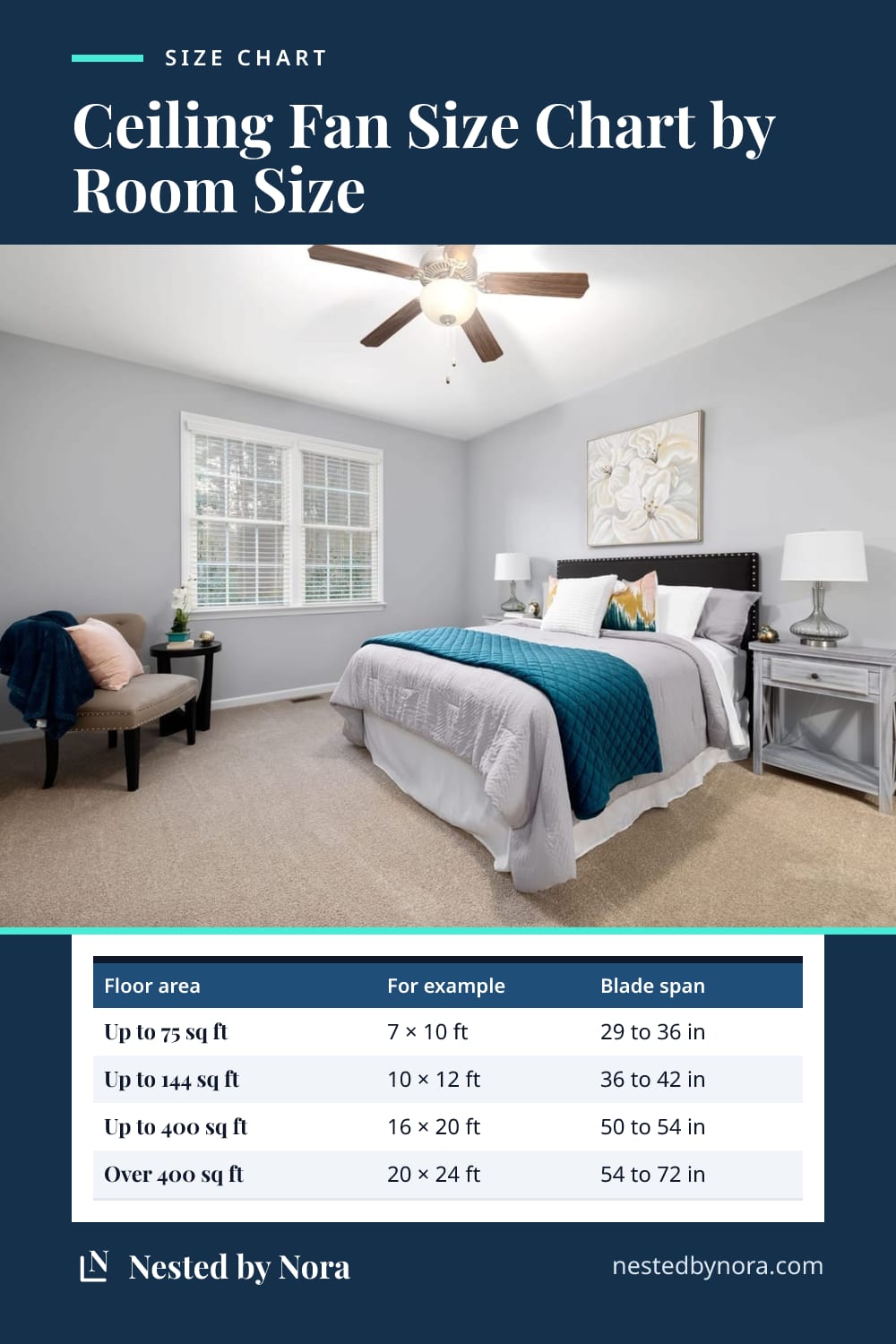
Save it for later
Pin this page so it's handy when you're ready to buy.
Save to Pinterest (opens in a new tab)