Wallpaper Calculator
Enter your room or one wall and the roll's width, length and pattern repeat from the label, and get the rolls to buy, the strips to cut and how many strips each roll gives.
By Nora Callahan · Updated
Your walls
Wallpaper to buy
12 rolls of wallpaper
The walls are 54 ft around, so they take 32 strips of 20.5 in paper. Each strip takes 9 ft 4 in: the 9 ft wall plus 4 in for trimming. A 33 ft roll gives 3 strips, so 32 strips take 11 rolls, plus 1 spare.
Your cutting list
| Strips to hang | 32 |
|---|---|
| Each strip | 9 ft 4 in |
| Strips per roll | 3, with 5 ft left over |
| Rolls | 11, plus 1 spare |
| Wall area | 486 sq ft, doors and windows included |
- Check that every roll has the same run or dye lot number: the color can vary between batches.
Doors and windows are left in, since you cut them out as you hang: see Doors and windows. How we calculate
The short answer
Count strips, not square feet. Divide the width of the walls by the roll’s width and round up for the strips. Each strip is the wall height plus about 4 in for trimming, rounded up to whole pattern repeats. Then see how many strips one roll gives, divide, round up, and add a spare roll.
A 12 × 15 ft bedroom with 8 ft walls takes 32 strips of 20.5 in paper, 8 ft 4 in each. A 33 ft roll gives 3 of them, so that’s 11 rolls and a spare: 12 rolls.
How to measure
- The walls: measure each wall you’ll paper along the floor, corner to corner, and add them up. For a whole room, measure it wall to wall both ways.
- The height: measure from the floor to the ceiling. If the walls aren’t all the same height, measure the highest point.
- The roll: read its width, its length and the pattern repeat on the label. The repeat is also on the back of the sample.
- Doors and windows: leave them in; see Doors and windows.
How to use the calculator
- Choose a whole room or one wall, and enter its size and the height. A room you entered in another tool carries over.
- Enter the roll’s width, length and pattern repeat from the label. Use 0 for a plain paper or a free match.
- Check the extra length for trimming, 4 in unless your paper’s instructions say otherwise, and whether to add a spare roll.
- Read the result: the rolls to buy, a cutting list and a drawing of the strips across your walls and one roll cut into strips.
- Save or share it. Copy link keeps your numbers in the address.
How we calculate
The counts are estimates. If your paper’s product page has its own roll calculator, that comes first.
- Strips: the width of the walls divided by the roll’s width, rounded up. Strips run floor to ceiling, so there are no seams across the wall.
- Each strip: the wall height plus 4 in for trimming, about 2 in at the ceiling and 2 in at the baseboard, rounded up to whole pattern repeats. That way every strip starts at the same point in the pattern. Adding one whole repeat to the height instead usually comes to about the same.
- Strips per roll: the roll’s length divided by the strip’s, rounded down, since a short piece can’t make a strip.
- Rolls: the strips divided by the strips per roll, rounded up, plus one spare roll unless you turn it off.
- Doors and windows: left in, since you cut them out as you hang.
Worked examples
Worked example
A 12 × 15 ft bedroom with 8 ft ceilings, plain paper
What we know
- Room: 12 ft × 15 ft, 8 ft high (54 ft around)
- Rolls: 20.5 in × 33 ft, no pattern repeat
How it works out
- Strips: 54 ft ÷ 20.5 in, rounded up = 32.
- Each strip: 8 ft + 4 in for trimming = 8 ft 4 in.
- Strips per roll: 33 ft ÷ 8 ft 4 in, rounded down = 3.
- Rolls: 32 ÷ 3, rounded up = 11, plus 1 spare.
12 rolls of wallpaper: 11 rolls for 32 strips and a spare.
Worked example
A 10 ft accent wall with a 21 in pattern repeat
What we know
- One wall: 10 ft wide, 8 ft high
- Rolls: 20.5 in × 33 ft, 21 in pattern repeat
How it works out
- Strips: 10 ft ÷ 20.5 in, rounded up = 6.
- Each strip: 8 ft + 4 in for trimming, in whole 21 in repeats = 8 ft 9 in.
- Strips per roll: 33 ft ÷ 8 ft 9 in, rounded down = 3.
- Rolls: 6 ÷ 3, rounded up = 2, plus 1 spare.
3 rolls of wallpaper: 2 rolls for 6 strips and a spare.
Worked example
A 12 × 14 ft dining room, 9 ft high, in a large pattern
What we know
- Room: 12 ft × 14 ft, 9 ft high (52 ft around)
- Rolls: 27 in × 27 ft, 25.25 in pattern repeat
How it works out
- Strips: 52 ft ÷ 27 in, rounded up = 24.
- Each strip: 9 ft + 4 in for trimming, in whole 25.25 in repeats = 10 ft 6.25 in.
- Strips per roll: 27 ft ÷ 10 ft 6.25 in, rounded down = 2.
- Rolls: 24 ÷ 2, rounded up = 12, plus 1 spare.
13 rolls of wallpaper: 12 rolls for 24 strips and a spare.
Wallpaper rolls for common rooms
The strips and rolls for common room sizes with 8 ft walls, in 20.5 in × 33 ft rolls with no pattern repeat. Add one spare roll to each.
| Room | Around | Strips | Rolls |
|---|---|---|---|
| 10 × 10 ft | 40 ft | 24 | 8 rolls |
| 10 × 12 ft | 44 ft | 26 | 9 rolls |
| 12 × 12 ft | 48 ft | 29 | 10 rolls |
| 12 × 15 ft | 54 ft | 32 | 11 rolls |
| 14 × 16 ft | 60 ft | 36 | 12 rolls |
| 16 × 20 ft | 72 ft | 43 | 15 rolls |
How many strips a roll gives
Full-height strips from three common rolls, with 4 in for trimming and no pattern repeat. A pattern repeat can only lower these.
| Roll | 8 ft walls | 9 ft walls | 10 ft walls |
|---|---|---|---|
| 20.5 in × 33 ft | 3 strips | 3 strips | 3 strips |
| 27 in × 27 ft | 3 strips | 2 strips | 2 strips |
| 53 cm × 10 m | 3 strips | 3 strips | 3 strips |
The 27 in × 27 ft roll is a double roll, and 53 cm × 10 m is a metric roll. Standard widths are 21, 27 and 42 in.
Pattern repeat and match
- The repeat: how far the pattern runs before it starts again, from 0 to 23 in on most papers. Larger patterns can take more rolls to match.
- The match: free, straight or offset. A free match wastes the least, since the strips line up any way. A straight match lines up across in a straight line, and a drop match in a V.
- Half-drop designs: every other strip shifts by half the repeat. Panels printed to length may need to be longer for them, so follow the maker’s calculator for a half-drop panel.
- Working from two rolls at once sometimes cuts down on waste when matching a pattern.
Doors and windows
The calculator measures right across doors and windows. There’s no need to deduct them: you cut them out as you hang, and leaving them in gives just the right amount of extra for mistakes.
Over a wide opening, you can take off the whole strips that fit across it. You’ll buy a little less, with less to spare for mistakes.
Buying the rolls
- Double rolls: wallpaper is often priced by the single roll but sold in double or triple rolls. Enter the length of the roll you’ll actually get.
- One run or lot: check that every roll has the same run or dye lot number, since the color can vary between batches.
- A spare roll: one, or two to be safe, for trimming, mistakes and patches later.
Before you hang
- The wall: clean, smooth and sound, with old wallpaper removed. For unpasted paper, put on a wallpaper primer or sealer first.
- Booking: fold a pasted strip onto itself for several minutes so it relaxes before it goes on the wall. Your paper’s instructions give the time.
- Trimming: 4 in of extra length per strip. Peel and stick can take less, 2 to 3 in, and pasted paper more, 6 to 8 in, so set the trim to match yours.
Then paint the other walls with the paint calculator, or pick the colors first with the room color palette generator.
Start in the least visible corner, usually the one closest to the entry: where the first and last strips meet is the one place the pattern won’t match.
Frequently asked questions
How many rolls of wallpaper do I need?
Count strips, not square feet: divide the width of the walls by the roll's width and round up, then see how many floor-to-ceiling strips one roll gives. A 12 by 15 foot bedroom with 8 foot walls takes 32 strips of 20.5 in paper. At 3 strips per 33 ft roll, that's 11 rolls, plus a spare.
How do you allow for the pattern repeat?
Round each strip up to whole repeats, so every strip starts at the same point in the pattern. The repeat is on the label or the back of the sample, 0 to 23 in on most papers. A large repeat can cost a strip per roll: a 9 foot wall in 27 inch rolls with a 25.25 inch repeat takes 10 ft 6.25 in per strip, so a roll gives only 2.
Should I subtract doors and windows for wallpaper?
There's no need to. Measure right across them: they're cut out as you hang, and the extra covers mistakes. Over a wide opening you can take off the whole strips that fit across it, but leaving them in is the safer side, and that's what the calculator does.
How much extra wallpaper should I buy?
One or two more rolls, for trimming, mistakes and patches later. Buy them all at once, with the same run or dye lot number on every roll.
What is a double roll of wallpaper?
Wallpaper is often priced by the single roll but sold in double or triple rolls. Count the rolls you'll actually get, by the length on the label. The most common roll is about 20.5 in × 33 ft.
How much extra length do you need for trimming?
About 4 in per strip, 2 in at the ceiling and 2 in at the baseboard. Peel and stick can take less, 2 to 3 in, and pasted paper more, 6 to 8 in, so check your paper's instructions.
Next step
Paint CalculatorEnter your room or one wall, the doors and windows and the coats, and get the gallons and quarts of wall paint to buy, with the ceiling and a coat of primer if you need them.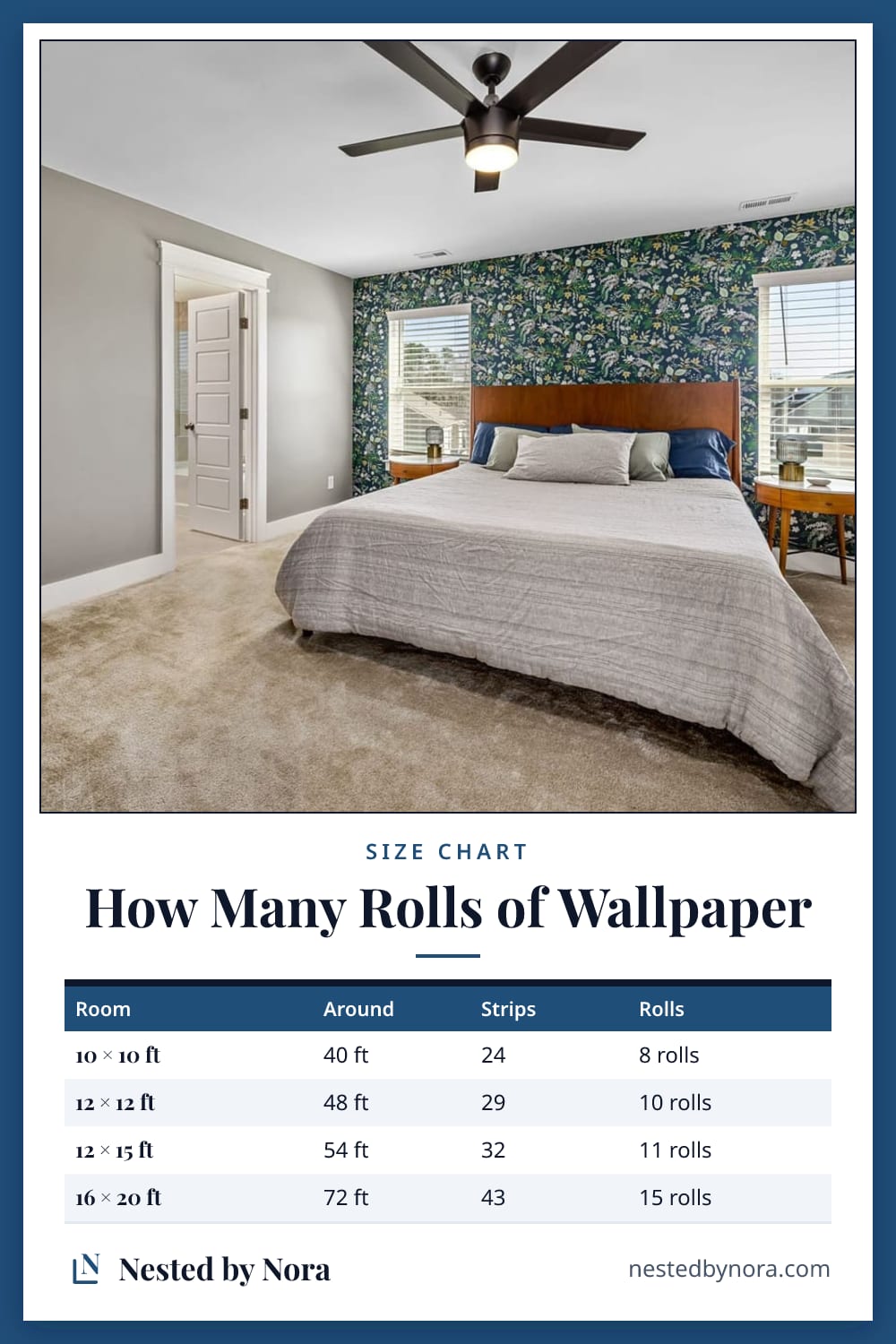
Save it for later
Pin this page so it's handy when you're ready to buy.
Save to Pinterest (opens in a new tab)