String Lights Length Calculator
Enter your patio's length and width, the layout and how far the lights start from the outlet, and get the feet of string lights to buy, the strands that make it up and the points to hang them from.
By Nora Callahan · Updated
Your space
Lights to get
66 ft of lights: three 24 ft strands
A zigzag of 4 passes across a 16 ft by 12 ft space runs 50.6 ft, 12.6 ft for each pass. Add 10% for the drape and the connections (5.1 ft) and the 10 ft to the outlet: 65.7 ft, so get at least 66 ft of lights. Three 24 ft strands give 72 ft, 6.3 ft to spare. Hang them 8 to 10 ft up from 5 anchor points, alternating between the two long sides, 8 ft apart on each side. An outdoor extension cord can cover the run to the outlet instead; then 56 ft of lights is enough. Check that the box lets you link three strands end to end. Use lights rated for outdoor use, plugged into a GFCI outlet.
Ways to buy them
- 3 × 24 ftFits72 ft, 6.3 ft to spare
- 2 × 48 ftFits96 ft, 30.3 ft to spare
- 1 × 100 ftFits100 ft, 34.3 ft to spare
Fits: covers the lights with 10% extra and the run to the outlet. Tight: covers them without the extra, so the lights hang taut.
Measure between the points the lights will hang from, and the cord's way to the outlet along the wall or the ground. The length on the box runs from the plug to the far end. How we calculate
The short answer
Measure the path the lights will take from anchor to anchor, add 10% for the drape and the connections, and add the run to the outlet. A 16 by 12 ft patio with a zigzag of four passes runs 50.6 ft; with the extra and 10 ft to the outlet, get 66 ft of lights, or three 24 ft strands.
Hang them 8 to 10 ft up, and keep each run between anchors to 20 ft or less, or add a support cable.
How to measure
- The space: measure the length and the width between the points the lights will hang from: posts, the house, a fence or a pergola, not the edge of the pavers.
- The outlet: measure the way the cord will run from the outlet to the first anchor, along the wall or the ground and up the post.
- Pick a layout: around the edge outlines the space, a zigzag fills it overhead, and a crisscross makes an X from corner to corner.
- Check it with string: run a string along the whole path, from the outlet, and measure the string.
How to use the calculator
- Choose a layout: around the edge, a zigzag or a crisscross.
- Enter the space’s length and width, and for a zigzag, how many times the lights cross it. More passes fill the space more densely and take more feet.
- Enter the distance from the outlet to the first anchor, or 0 if the lights start right at it.
- Read the result: the feet of lights to get, the strands that add up to it, how many anchors to hang them from and whether a run needs a support cable. Every way to buy the strands is listed as Fits or Tight, with what it leaves to spare.
- Save or share it. Copy link keeps your numbers in the address.
How we calculate
The math measures the path the lights take and adds slack for the drape. The instructions that come with your lights come first.
- The path: the lights’ run from anchor to anchor. Around the edge, it’s the perimeter: twice the length plus twice the width. A zigzag runs back and forth across the short side, between two lines of anchors along the long sides, or two guide wires. Each pass runs corner to corner, so it’s a little longer than the width. A crisscross is an X: the two diagonals, joined along one short side so one run of lights makes it.
- The extra: 10% of the path for the drape and the connections. Leave that slack: a strand pulled taut looks shorter and less inviting.
- The outlet: the run from the outlet to the first anchor, added as measured.
- The strands: 24, 48 and 100 ft, the lengths string lights come in. For each length, the fewest strands that cover it Fit; one fewer is Tight when it still covers the path and the outlet without the extra. The answer is the way to buy them with the fewest feet to spare, the longer strand on a tie.
- The anchors: around the edge, posts split each side into equal runs of 20 ft or less; a zigzag hangs from a point at each end of every pass; a crisscross from the four corners. Any span over 20 ft gets a support cable.
Worked examples
Worked example
A 16 × 12 ft patio in a zigzag of 4 passes, 10 ft from the outlet
What we know
- Space: 16 ft × 12 ft
- Layout: zigzag, 4 passes
- Outlet: 10 ft from the first anchor
How it works out
- Path: each pass crosses 12 ft while moving 4 ft along, 12.65 ft corner to corner; 4 × 12.65 ft = 50.6 ft.
- Lights: 50.6 ft + 10% (5.1 ft) + the outlet (10 ft) = 65.7 ft.
- Strands: 3 × 24 ft = 72 ft, 2 × 48 ft = 96 ft or 1 × 100 ft = 100 ft; 3 × 24 ft leaves the fewest feet to spare.
66 ft of lights: three 24 ft strands. A zigzag of 4 passes across a 16 ft by 12 ft space runs 50.6 ft, 12.6 ft for each pass. Add 10% for the drape and the connections (5.1 ft) and the 10 ft to the outlet: 65.7 ft, so get at least 66 ft of lights. Three 24 ft strands give 72 ft, 6.3 ft to spare. Hang them 8 to 10 ft up from 5 anchor points, alternating between the two long sides, 8 ft apart on each side. An outdoor extension cord can cover the run to the outlet instead; then 56 ft of lights is enough. Check that the box lets you link three strands end to end. Use lights rated for outdoor use, plugged into a GFCI outlet.
Worked example
Around the edge of a 24 × 16 ft deck, 6 ft from the outlet
What we know
- Space: 24 ft × 16 ft
- Layout: around the edge
- Outlet: 6 ft from the first anchor
How it works out
- Path: 2 × (24 ft + 16 ft) = 80 ft.
- Lights: 80 ft + 10% (8 ft) + the outlet (6 ft) = 94 ft.
- Strands: 4 × 24 ft = 96 ft, 2 × 48 ft = 96 ft or 1 × 100 ft = 100 ft; 2 × 48 ft leaves the fewest feet to spare, the longer strand on a tie.
94 ft of lights: two 48 ft strands. Around all four sides of a 24 ft by 16 ft space, the lights run 80 ft. Add 10% for the drape and the connections (8 ft) and the 6 ft to the outlet: 94 ft of lights. Two 48 ft strands give 96 ft, 2 ft to spare. Hang them 8 to 10 ft up from 6 anchor points, the corners and posts between them, so no run is longer than 20 ft. An outdoor extension cord can cover the run to the outlet instead; then 88 ft of lights is enough. Check that the box lets you link two strands end to end. Use lights rated for outdoor use, plugged into a GFCI outlet.
Worked example
A 20 × 15 ft yard crisscrossed corner to corner, 25 ft from the outlet
What we know
- Space: 20 ft × 15 ft
- Layout: crisscross
- Outlet: 25 ft from the first anchor
How it works out
- Path: two diagonals of 25 ft and the 15 ft side between them = 65 ft.
- Lights: 65 ft + 10% (6.5 ft) + the outlet (25 ft) = 96.5 ft.
- Strands: 5 × 24 ft = 120 ft, 3 × 48 ft = 144 ft or 1 × 100 ft = 100 ft; 1 × 100 ft leaves the fewest feet to spare.
97 ft of lights: one 100 ft strand. Corner to corner both ways across a 20 ft by 15 ft space, joined along a 15 ft side, the lights run 65 ft. Add 10% for the drape and the connections (6.5 ft) and the 25 ft to the outlet: 96.5 ft, so get at least 97 ft of lights. One 100 ft strand gives 100 ft, 3.5 ft to spare. Hang them 8 to 10 ft up from the 4 corners. The longest run between anchors, 25 ft, is over 20 ft: add a support cable and hang the lights from it. An outdoor extension cord can cover the run to the outlet instead; then 72 ft of lights is enough. Use lights rated for outdoor use, plugged into a GFCI outlet.
String lights by patio size
The lights for common patio sizes in each layout, with the 10% extra. Add the run to the outlet.
| Space | Around the edge | Zigzag, 4 passes | Crisscross |
|---|---|---|---|
| 10 × 10 ft | 44 ft | 46 ft | 43 ft |
| 12 × 12 ft | 53 ft | 55 ft | 51 ft |
| 16 × 12 ft | 62 ft | 56 ft | 58 ft |
| 20 × 16 ft | 80 ft | 74 ft | 74 ft |
| 24 × 20 ft | 97 ft | 92 ft | 91 ft |
| 30 × 20 ft | 110 ft | 94 ft | 102 ft |
A zigzag with more passes takes more feet: each pass adds about the width of the space.
How many strands
The strands that make up a length of lights, with the fewest feet to spare.
| Lights needed | Strands | Together |
|---|---|---|
| 30 ft | 1 × 48 ft | 48 ft |
| 50 ft | 3 × 24 ft | 72 ft |
| 70 ft | 3 × 24 ft | 72 ft |
| 90 ft | 2 × 48 ft | 96 ft |
| 120 ft | 5 × 24 ft | 120 ft |
| 150 ft | 7 × 24 ft | 168 ft |
| 200 ft | 2 × 100 ft | 200 ft |
If your lights come in other lengths, the math works the same way: divide the length by the strand and round up. Then check the box for how many strands link end to end. The limit differs from model to model, even within one brand, so look up the limit for your lights.
Hanging them
- Height: 8 to 10 ft above the ground. Where there’s nothing to hang from, set string light poles that tall.
- Between anchors: add a support cable for spans over 20 ft: a coated steel cable, kept tight for straight runs or a little loose for a drape. Space string light poles 15 to 25 ft apart. Some lights’ instructions also ask you to attach them to a structural support at least every 24 ft.
- Mounting: use the mounting loops or hooks the lights come with, and don’t staple or nail the wiring.
Safety outdoors
- Outdoor-rated lights: only lights rated for outdoor use go outside. Lights rated for wet locations suit fully exposed runs, and dry-rated lights never go outdoors.
- A GFCI outlet: plug outdoor string lights into a GFCI outlet, and have an electrician add one if there isn’t one. The National Electrical Code requires GFCI protection on outdoor outlets in new homes. The requirement applies mainly to new construction, so check the outlet in an older house.
- Extension cords: use only cords marked for outdoor use, and don’t plug one extension cord into another.
- Pools and spas: keep the lights at least 16 ft away.
Before you buy
Look at where the lights will plug in before you pick a layout: a run that starts near the outlet needs the shortest cord. To shade the same patio in the daytime, the patio umbrella size calculator sizes the umbrella for your table or seating area.
Run a string or a clothesline along the path before you buy, from the outlet to the last anchor, and measure it. It shows the real path, corners and all, and where the anchors need to go.
Frequently asked questions
How many feet of string lights do I need?
Measure the path the lights will take between the points they hang from, add 10% for the drape and the connections, and add the run to the outlet. A 16 by 12 foot patio with a zigzag of four passes, 10 feet from the outlet, takes 66 ft: three 24 ft strands.
How do you figure string lights for a zigzag?
Each pass runs corner to corner across the short side, so it's a little longer than the width. On a 16 by 12 foot patio with four passes, each pass is 12.6 ft, and the four come to 50.6 ft before the extra and the run to the outlet.
How many string lights do you need to go around a patio?
Twice the length plus twice the width, with 10% extra and the run to the outlet. A 24 by 16 foot deck 6 feet from the outlet takes 94 ft: two 48 ft strands.
How high should patio string lights hang?
About 8 to 10 ft above the ground. That leaves enough clearance for people to walk under them, and gives comfortable light over the space.
How far apart should string light poles be?
Keep each run between poles or hooks to 20 ft or less, or add a support cable. Space string light poles 15 to 25 ft apart. Some lights' instructions also ask for a support at least every 24 ft, so check yours.
How many strands of string lights can you connect?
It depends on the lights, so check the box or the manual. The limit differs from model to model, even within one brand, and it's often listed in watts as well as in strands. If your run needs more, start a second run from another outlet instead of going past it.
Do outdoor string lights need a GFCI outlet?
Yes. Plug outdoor lights into a GFCI outlet. The National Electrical Code requires GFCI protection on the outdoor outlets of new homes, but an older house may not have one, so check, and ask an electrician to add one if it doesn't.
Next step
Patio Umbrella Size CalculatorEnter your patio table, round or rectangular, or the size of a seating area, and get the umbrella to look for: a canopy that reaches past the edge so the chairs are in the shade, and the base it needs.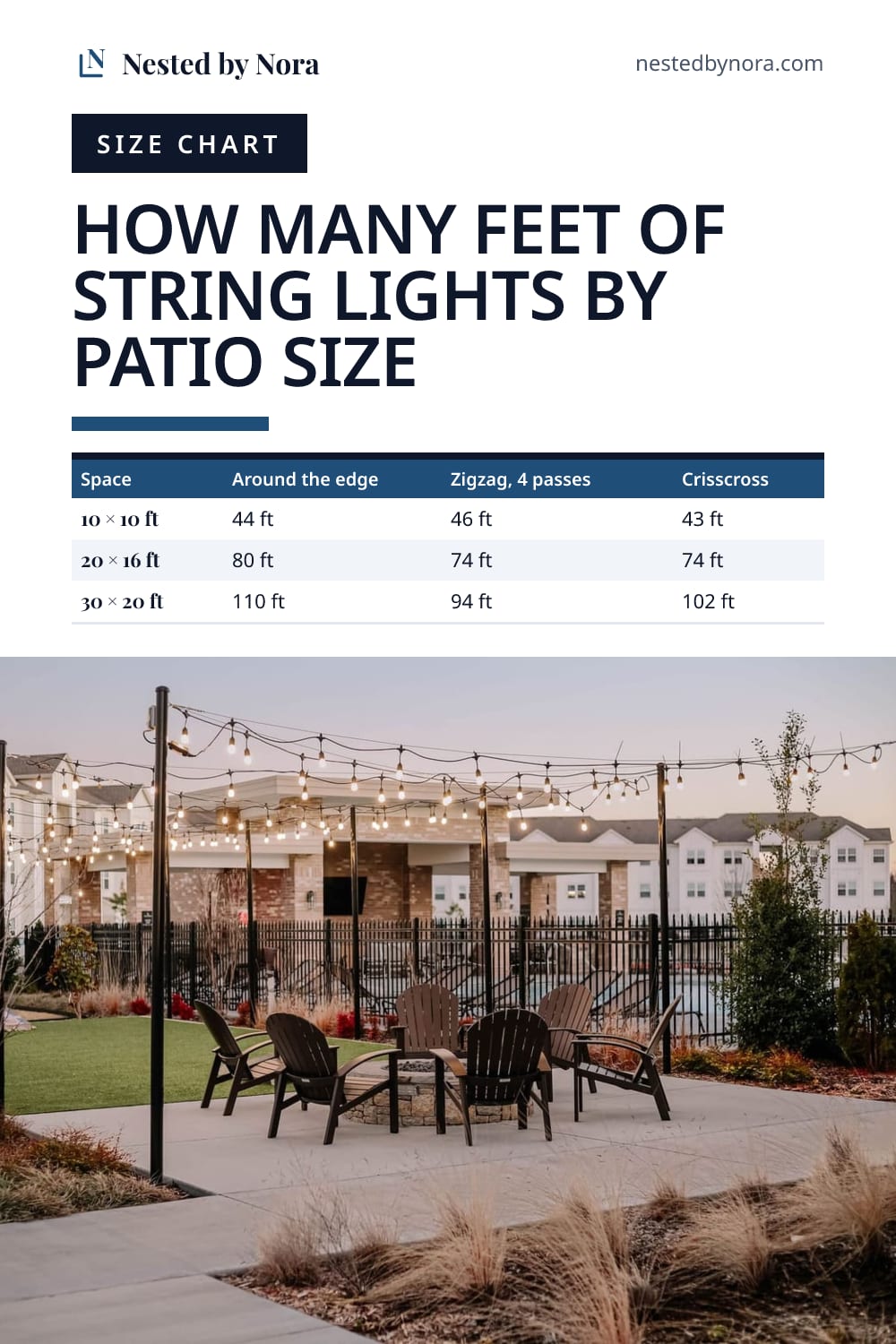
Save it for later
Pin this page so it's handy when you're ready to buy.
Save to Pinterest (opens in a new tab)