Blind Size Calculator
Choose a blind or shade, enter the window as your tape measure reads it and the frame's depth, and see the size to order inside or outside the frame, and whether the frame is deep enough.
By Nora Callahan · Updated
Your window
Size to order
Order 34 1/2 × 60 in, inside mount
Order the opening's narrowest width and longest height to the 1/8 in, with no deductions: the factory makes the faux wood blind about 1/2 in narrower so it clears the frame. At 3 1/4 in deep, the frame takes faux wood blinds flush. Raised, the faux wood blind stacks about 7 3/8 in at the top of the window.
Both mounts
- Inside: 34 1/2 × 60 inFitsNo deductions; the factory takes them
- Outside: 37 1/2 × 63 inFits1 1/2 in past each side, 3 in above, to the sill
Inside: the narrowest width rounded down and the longest height rounded up, to the 1/8 in. Outside: the overlap past each side, 3 in above the opening and the sill or 2 in below it.
Inside this frame
- Mini blindsFitsFlush from 1 3/4 in
- Faux wood blindsFitsFlush from 2 3/4 in
- Cellular shadesFitsFlush from 2 1/8 in
- Roller shadesFitsFlush from 2 1/2 in
- Roman shadesFitsFlush from 3 1/8 in
Fits: the frame is as deep as the product's flush depth, so it sits inside. Tight: from its minimum depth, with the front sticking out.
- Measure with a steel tape to the nearest 1/8 in, width first, then height, and measure every window on its own.
- Give the opening's exact size, not the old blind's, and take no deductions: yours plus the factory's makes it too narrow. Stock blinds you trim yourself are the exception: take 1/2 in off the width.
- Measure both diagonals too. If they differ by more than 1/4 to 1/2 in, the window is out of square, and an outside mount hides it.
- An inside mount leaves a small gap at each side that lets some light in; an outside mount blocks more.
- Buying a stock size? Round the width down and the height up to the next size. Labels can be rounded: a mini blind sold as 35 in wide is 34 1/2 in.
- Choose cordless for every room where a child may be: about 9 children under 5 die each year from window covering cords, the CPSC says. Stock blinds sold since 2018 are cordless or keep their cords out of reach.
The short answer
For an inside mount, order the window opening’s exact size: the narrowest of three width readings and the longest of three height readings, to the nearest 1/8 in, with no deductions. The factory makes the blind slightly narrower so it fits in the frame.
For an outside mount, add at least 1 1/2 in past each side, or 3 in for roller shades, and run the blind from 3 in above the opening down to a sill that sticks out, or 2 in below the sill. An inside mount also needs a deep enough frame: faux wood blinds need 3/4 in and sit flush from 2 3/4 in.
How to measure
- The width: with a steel tape, measure inside the frame at the top, the middle and the bottom, and keep the narrowest.
- The height: measure from the top of the opening to the sill at the left, the middle and the right, and keep the longest.
- The depth: measure from the front of the frame to the glass at the top, and note any crank or handle that sticks out.
- The diagonals: measure corner to corner both ways. If they differ by more than 1/4 to 1/2 in, the window is out of square.
Write the width first, then the height, and measure every window on its own. Measure the opening itself, not the old blind.
How to use the calculator
- Choose the blind or shade and the mount, inside or outside the frame.
- Enter the opening’s width and height as the tape reads them. Fractions work, the way a tape measure shows them.
- Enter the frame’s depth, and check whether the sill sticks out past the wall.
- Read the result: the size to order, both mounts side by side, every product labeled by how this frame holds it, and how tall the raised blind stacks. When the frame is too shallow for an inside mount, the result turns to an outside one. Copy link keeps your numbers in the address, and the next step goes to the curtain size calculator.
How we calculate
Everything starts from the opening as you measured it, inside the frame.
- Inside mount: the narrowest width rounded down and the longest height rounded up to the 1/8 in. No deductions: the factory takes about 1/2 in off faux wood blinds and 3/8 in off cellular and Roman shades, and leaves a light gap of about 9/16 in a side on cordless roller shades.
- Fits and Tight: a frame as deep as the product’s flush depth Fits. From the product’s minimum depth it’s Tight: the blind goes in, but the headrail sticks out past the frame. Shallower than that, the calculator turns to an outside mount.
- Outside mount: 1 1/2 in past each side for blinds and for cellular and Roman shades, 3 in for roller shades, from 3 in above the opening down to a sill that sticks out, or 2 in below the sill. Where the wall beside the window is tight, overlap at least 3/4 in a side.
- The stack: how tall the raised blind is, worked out from the stacks of the nearest shorter and taller blinds. Outside, the calculator takes off the 3 in above the opening to show how much of the glass the stack covers.
The depths are for one common version of each product: 1 inch metal mini blinds, 2 inch faux wood blinds, cordless roller shades and continuous loop Roman shades. Other versions and valances change them, so check the product’s own minimum depth before you order.
Worked examples
Worked example
Faux wood blinds inside a 34 1/2 × 60 in window
What we know
- Window: 34 1/2 × 60 in inside the frame, 3 1/4 in deep; the sill sticks out
- Faux wood blinds, inside mount
How it works out
- Depth: 3 1/4 in, at least the 2 3/4 in faux wood blinds need to sit flush: Fits.
- Width: the narrowest reading, rounded down to the 1/8 in: 34 1/2 in. Height: the longest, rounded up: 60 in.
- Stack: raised, about 7 3/8 in at the top of the window.
Order 34 1/2 × 60 in, inside mount.
Worked example
A roller shade for a frame 1 1/2 in deep
What we know
- Window: 34 1/2 × 60 in inside the frame, 1 1/2 in deep; the sill sticks out
- Roller shades, inside mount
How it works out
- Depth: 1 1/2 in, under the 2 in roller shades need inside: Doesn't fit, so mount them outside.
- Width: 34 1/2 in plus 3 in past each side: 40 1/2 in.
- Height: 3 in above the opening, the 60 in window down to the sill: 63 in.
Order 40 1/2 × 63 in, outside mount.
Worked example
Cellular shades outside a 48 × 60 in window with no sill sticking out
What we know
- Window: 48 × 60 in inside the frame, 3 1/4 in deep; no sill sticking out
- Cellular shades, outside mount
How it works out
- Width: 48 in plus 1 1/2 in past each side: 51 in.
- Height: 3 in above the opening, the 60 in window and 2 in below the sill: 65 in.
- Stack: raised, about 3 in, above the glass.
Order 51 × 65 in, outside mount.
Frame depth for inside mount blinds
Each product needs its own depth to go inside the frame, and more to sit flush with its front. A frame under 3/4 in deep usually can’t take an inside mount at all.
| Blind or shade | Inside, at least | Inside, flush | Outside, each side |
|---|---|---|---|
| Mini blinds | 1 in | 1 3/4 in | 1 1/2 in |
| Faux wood blinds | 3/4 in | 2 3/4 in | 1 1/2 in |
| Cellular shades | 3/4 in | 2 1/8 in | 1 1/2 in |
| Roller shades | 2 in | 2 1/2 in | 3 in |
| Roman shades | 3/4 in | 3 1/8 in | 1 1/2 in |
A frame between the two depths still works, with the headrail and valance sticking out a little. If the frame is out of square, or a crank or handle is in the way, mount outside instead.
Inside or outside mount
- Inside: the mount for most windows, unless the frame is too shallow or something is in the way, and the better choice when the window also has curtains. It leaves a small gap at each side that lets some light in.
- Outside: it suits a shallow frame, a crank or handle in the way and a window that isn’t square or level, and it blocks more light. The brackets need 2 in of flat wall or trim above the window.
- Both, for the same window: a 34 1/2 × 60 in window 3 1/4 in deep takes 34 1/2 × 60 in faux wood blinds inside, and 37 1/2 × 63 in outside with a sill that sticks out. In a frame only 1 1/2 in deep, a roller shade has to go outside, at 40 1/2 × 63 in.
How much a raised blind covers
A raised blind stacks at the top of the window. How tall the stack is depends on the blind and its height.
| Blind height | Mini blinds | Faux wood blinds | Cellular shades |
|---|---|---|---|
| 48 in | 4 1/4 in | 6 3/8 in | 3 in |
| 60 in | 4 5/8 in | 7 3/8 in | 3 in |
| 72 in | 5 in | 8 3/8 in | 3 in |
| 84 in | 5 3/8 in | 9 3/8 in | 3 1/4 in |
Inside the frame, the stack hides the top of the glass: about 7 3/8 in for faux wood blinds at the height in the first example. Outside, mount the blind higher, by the stack’s height, to clear the glass when it’s up. Of the three, cellular shades stack the least, about 3 in with their rails, so a 48 × 60 in window’s 51 × 65 in shade clears the glass.
Rounding, deductions and stock sizes
- Rounding: a finer reading rounds down for the width and up for the height. A 35 3/16 in width orders as 35 1/8 in, and a 59 15/16 in height as 60 in.
- No deductions: your own deduction plus the factory’s makes a double deduction and a blind too narrow for the frame.
- Stock sizes: off-the-shelf blinds fit windows 24 to 60 in wide and 36 to 72 in long, usually in 2 in width steps up to about 72 in. Round the width down and the height up to the next size. Labels can be rounded: a mini blind sold as 35 in wide is 34 1/2 in.
- Trim to fit: stock blinds you cut to width yourself take 1/2 in off the width.
Cord safety
Window covering cords can strangle young children: about 9 children under 5 die from them each year, some with an adult nearby, and the CPSC calls cordless coverings the only way to remove the hazard. It recommends them for every room where a child may be. Since 2018, the industry’s safety standard asks for stock blinds and shades sold in stores and online to be cordless, or to have cords out of reach or no longer than 8 in.
With the blinds sized, frame the window with the curtain size calculator, which gives the rod and the panels. Painting first? The paint calculator works out the gallons for the walls around it.
These measuring rules hold for most blinds and shades, but each product’s own guide decides its deductions, its minimum depth and its brackets. Check it before you order, and follow its installation instructions.
Frequently asked questions
What size blinds do I need for an inside mount?
The window's exact opening. Measure the width inside the frame at the top, middle and bottom and use the narrowest, and the height at the left, middle and right and use the longest, to the nearest 1/8 in. Take no deductions: the factory makes the blind slightly narrower so it fits.
How much bigger than the window should outside mount blinds be?
At least 1 1/2 in past each side, 3 in in all, and 3 in a side for roller shades. Start the blind 3 in above the opening and end it on a sill that sticks out, or 2 in below the sill. A 34 1/2 × 60 in window takes 37 1/2 × 63 in faux wood blinds outside.
How deep does a window frame need to be for inside mount blinds?
It depends on the product. Faux wood blinds need 3/4 in and sit flush from 2 3/4 in, mini blinds 1 in and 1 3/4 in, cellular shades 3/4 in and 2 1/8 in, and cordless roller shades 2 in and 2 1/2 in. With only the minimum, the front sticks out past the frame.
Should I round window measurements up or down for blinds?
Measure to the nearest 1/8 in. Round a finer reading down for the width and up for the height: a 35 3/16 in width orders as 35 1/8 in, and a 59 15/16 in height as 60 in.
Do I take deductions when measuring for blinds?
Not for an inside mount you order to size. Give the exact opening, and the factory takes about 1/2 in off faux wood blinds and 3/8 in off cellular and Roman shades. Taking your own as well makes a double deduction. Stock blinds you trim yourself are different: take 1/2 in off the width.
Inside or outside mount blinds, which is better?
Inside, for most windows. Choose outside instead when the frame is too shallow, a crank or handle is in the way, or the window is out of square, or to block more light, since an inside mount leaves small gaps at the sides.
What are the standard blind sizes?
Off-the-shelf blinds fit common windows 24 to 60 in wide and 36 to 72 in long, usually in 2 in width steps up to about 72 in. Labels can be rounded: a mini blind sold as 35 in wide is 34 1/2 in. Round the width down and the height up to the next size.
Are corded blinds safe with young children?
No. About 9 children under 5 die each year from window covering cords, and the CPSC says cordless coverings are the only way to remove the hazard. Since 2018, the industry's safety standard asks for stock blinds sold in stores and online to be cordless or keep their cords out of reach.
Next step
Curtain Size CalculatorEnter your window and ceiling, how long and how full you want the curtains, and get the rod's length and height, the standard panel length that ends where you want it, and how many panels to buy.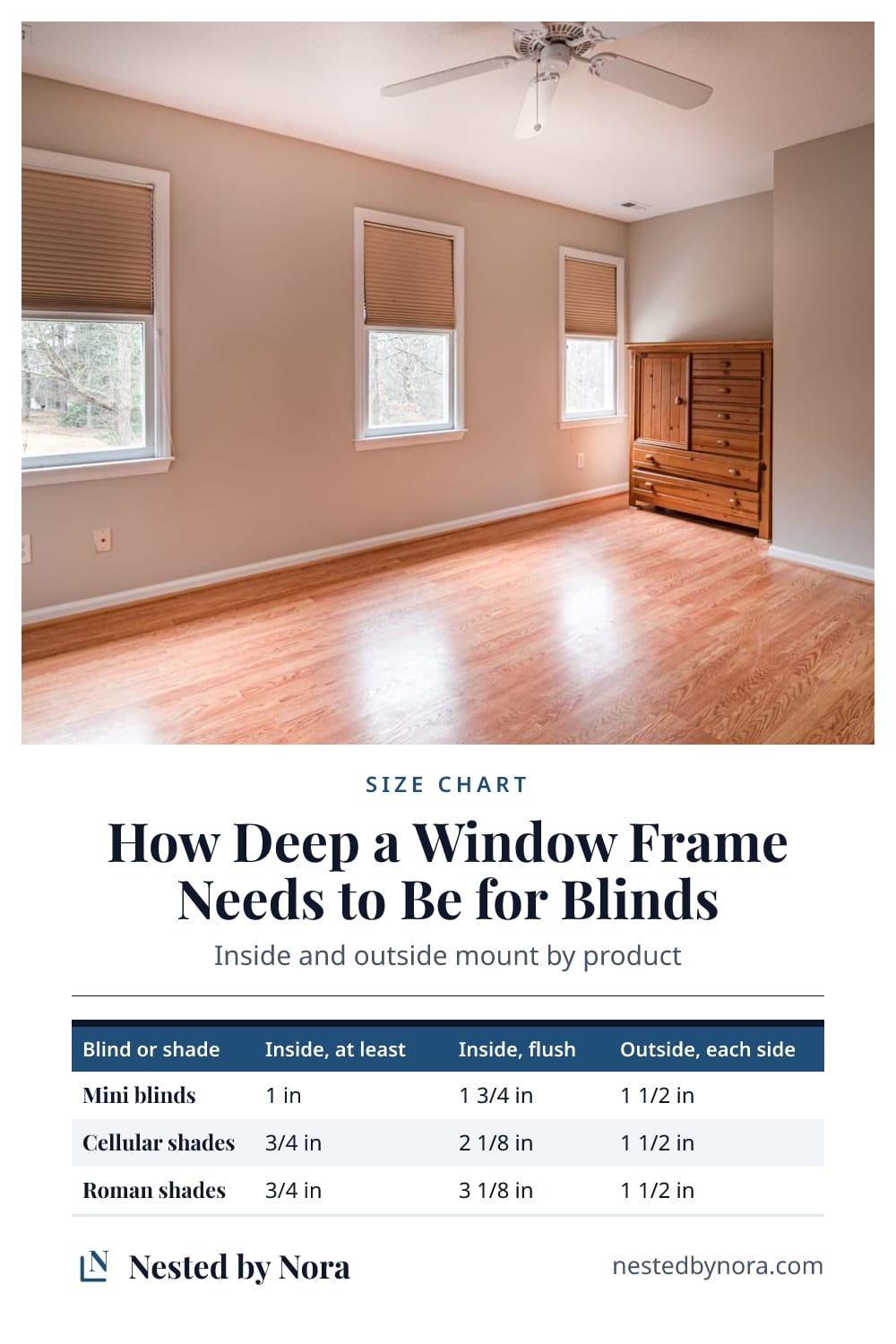
Save it for later
Pin this page so it's handy when you're ready to buy.
Save to Pinterest (opens in a new tab)