Picture Hanging Height Calculator
Enter the frame's height and how far its hanger sits below the top, and get the spot for the hook from the floor, on an open wall, above furniture or on a stair wall.
By Nora Callahan · Updated
Your frame
Where the hook goes
Hook at 64 in from the floor
Put the bottom of the hook on that mark, and the center of the frame lands at 57 in, right at gallery height. The frame runs from 47 in to 67 in.
- Hook (bottom of the hook)
- 64 in
- Top of the frame
- 67 in
- Center of the frame
- 57 in
- Bottom of the frame
- 47 in
Measure up from the floor, not from the baseboard. Two D-rings? Use two hooks at this height, spaced like the rings. How we calculate

The short answer
Hang a picture so its center sits about 57 in from the floor. On an open wall, anything from 57 in to 60 in looks right. Above a sofa, bed or console, go by the furniture instead: leave about 8 in between the furniture and the bottom of the frame.
The nail doesn’t go at the center, though. It goes where the hanger will rest, which is why the calculator asks how far the wire or D-ring sits below the top of the frame. For a 16 by 20 inch frame whose wire pulls up 3 inches below the top, the hook goes at 64 in.
Still choosing the piece? The wall art size calculator gives the width to look for above a sofa, bed or console. Hanging several frames together? The gallery wall layout generator treats the group as one piece and gives you a hanging map with every nail.
How to measure
- Frame height: measure the outside of the frame from top to bottom, the way it will hang.
- Hanger drop: with a wire, pull it up toward the top of the frame as if it were on the hook, and measure from the top of the frame to the wire. With D-rings or a sawtooth hanger, measure from the top of the frame to the hanger.
- Above furniture: measure from the floor to the top of the sofa back, the headboard or the console.
- Stair wall: you’ll measure up from the step directly below where the center of the piece will be.
How to use the calculator
- Choose where you’re hanging it: an open wall, above furniture, or a stair wall.
- Enter the frame height and the hanger drop. On an open wall or a stair wall, the center height starts at 57 in; change it if you prefer a higher or lower line. Above furniture, enter its height and the gap you want.
- Read the result. You get the hook height, plus where the top, center and bottom of the frame land, so you can check it against a window, a light switch or the ceiling.
- Save or share it. Copy link keeps your numbers in the address. Switch to centimeters with the toggle at the top.
How we calculate
- The center line. The center of a framed piece goes about 57 in from the floor, near the eye height of an adult standing in front of it. Museums hang close to that, often at 58 in on center, for an adult eye height of 60 in. A center up to 60 in still looks right, so the calculator calls anything from 57 in to 60 in a typical height.
- Above furniture. The frame’s bottom edge goes the gap you choose above the top of the furniture, 8 in to start, and a gap of 6 in to 12 in works. The center then lands wherever the frame puts it, often above 60 in over a tall headboard, and that’s expected.
- Stair walls. The same center height, measured from the tread directly below the piece. Each piece on a stair wall gets its own measurement, so a row of frames climbs with the stairs.
- The hook. Half the frame’s height above the center gives the top of the frame. Subtract the hanger drop and you have the hook height. The bottom of the hook goes on that mark.
- Rounding. Heights are shown to the nearest quarter inch (or half centimeter). A level and a pencil mark are more precise than any rule here, so treat the result as the spot to start from.
If most of your household is tall, measure your own eye height and use it as the center. Just keep pieces that hang together on one line.
Worked examples
Worked example
A 16 × 20 in frame on an open wall
What we know
- Frame height: 20 in
- Hanger drop: 3 in
- Center height: 57 in
How it works out
- The center goes at 57 in.
- Half the frame, 10 in, puts the top at 67 in.
- The hanger sits 3 in below the top, so the hook goes at 67 in − 3 in = 64 in.
Put the bottom of the hook 64 in from the floor.
Worked example
A 24 in tall print above a sofa
What we know
- Frame height: 24 in
- Hanger drop: 4 in
- Furniture: 34 in tall
- Gap above it: 8 in
How it works out
- The bottom of the frame goes 8 in above the furniture: 34 in + 8 in = 42 in.
- Half the frame, 12 in, puts the center at 54 in and the top at 66 in.
- The hanger sits 4 in below the top, so the hook goes at 66 in − 4 in = 62 in.
Put the bottom of the hook 62 in from the floor.
Worked example
A 30 in tall piece on a stair wall
What we know
- Frame height: 30 in
- Hanger drop: 5½ in
- Center height: 57 in above the step below
How it works out
- The center goes at 57 in, measured straight up from the step below the frame.
- Half the frame, 15 in, puts the top at 72 in.
- The hanger sits 5½ in below the top, so the hook goes at 72 in − 5½ in = 66½ in.
Put the bottom of the hook 66½ in above the step below it.
Picture hanging height by frame size
With the center at 57 in, here’s where the top and bottom of common frame heights land. Subtract your hanger drop from the top to get the hook.
| Frame height | Top of frame | Bottom of frame |
|---|---|---|
| 10 in | 62 in | 52 in |
| 14 in | 64 in | 50 in |
| 20 in | 67 in | 47 in |
| 24 in | 69 in | 45 in |
| 30 in | 72 in | 42 in |
| 36 in | 75 in | 39 in |
| 40 in | 77 in | 37 in |
| 48 in | 81 in | 33 in |
A bigger frame doesn’t need a higher center. It reaches lower and higher around the same line, which is what keeps a wall of mixed sizes looking even.
Before you put the nail in
- Mark the hook height lightly in pencil where the center of the piece will be, side to side.
- Find a stud if the piece is heavy. A stud finder shows where the studs are; if none sits at your mark, use a wall anchor instead.
- Use hardware rated for the weight. Picture hangers list their weight limits on the package. Choose one rated higher than you think you need, with a stud or a sturdy wall anchor for heavy pieces.
- Hang it, then level it. Put the bottom of the hook on the mark, hang the piece and adjust until it’s level.
Follow the weight limit on your hanger’s package, and use a stud or a wall anchor rated for the weight for anything heavy. If you’re using adhesive strips, follow the maker’s instructions, which can rule out hanging pictures above a bed, on wallpaper, or anything valuable or irreplaceable.
Before the nail goes in, cut a piece of kraft paper the size of the frame and tape it to the wall at the height the calculator gives. Mark where the hanger falls on the paper and put the nail through that mark, then tear the paper away.
Frequently asked questions
How high should you hang pictures?
With the center of the picture about 57 in from the floor, or a little higher, up to 60 in. For a 16 by 20 inch frame whose wire pulls up 3 inches below the top, that puts the hook at 64 in.
What is the 57 inch rule for hanging pictures?
It's the habit of hanging art with its center about 57 in from the floor, close to the eye height of an adult standing in front of it, and museums and galleries hang by the same rule of thumb. A museum often goes a touch higher, about 58 in on center, from an adult eye height traditionally taken as 60 in.
How high should you hang art above a couch?
Leave a gap of about 8 in between the top of the sofa back and the bottom of the frame. Anything from 6 in to 12 in keeps the art and the sofa together as one group.
How high do you hang pictures on a stairway wall?
At the same height as on a flat wall, measured from the stair tread directly below the center of each piece, so the pictures climb with the stairs. Aim for 57 in to 60 in above the tread.
Should pictures be hung higher in a hallway?
A little higher is fine where people only walk past: in a hallway, the center can go up to about 66 in. Keep pictures that hang together at one height.
What if the frame has two D-rings instead of a wire?
Measure from the top of the frame to the top of the D-rings and use that as the hanger drop. Put two hooks at the height the calculator gives, as far apart as the rings.
Next step
Gallery Wall Layout GeneratorEnter your frames and your wall, pick a layout, and see the arrangement drawn to scale with every nail measured from the floor. Then print the hanging map.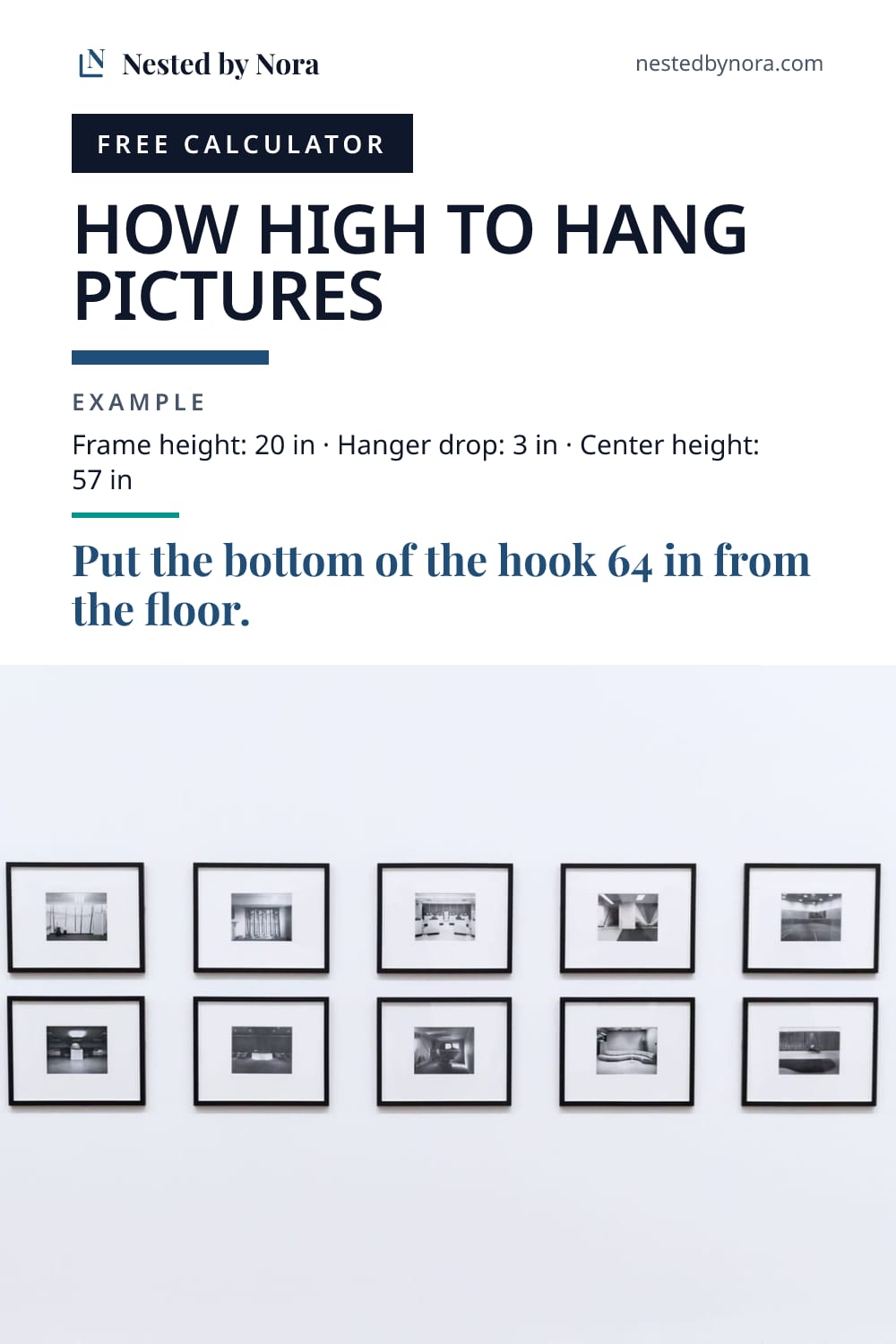
Save it for later
Pin this page so it's handy when you're ready to buy.
Save to Pinterest (opens in a new tab)