Curtain Size Calculator
Enter your window and ceiling, how long and how full you want the curtains, and get the rod's length and height, the standard panel length that ends where you want it, and how many panels to buy.
By Nora Callahan · Updated
Your window
Curtains to look for
Two 96 in panels on a 53.3 in rod
Extend the rod 6.7 in past each side of the window, a sixth of its width, so the open curtains stack beside the glass: a 53.3 in rod, bracket to bracket. An adjustable rod sold as 48 to 86 in covers it; over 48 in, give it a center bracket. Mount the rod with its top 96.5 in from the floor, 12.5 in above the window; toward the ceiling is halfway to two-thirds of the way up, 96 to 100 in. 96 in panels then end 0.5 in above the floor. At 2× fullness the curtains add up to 107 in across: two panels 54 in wide, one pair that opens from the middle.
Standard lengths
- 84 inDoesn't fittoo short for this rod height
- 95 inFitsrod top at 96 in, ends 1 in above the floor
- 96 inFitsrod top at 96.5 in, ends 0.5 in above the floor
- 108 inTighthem it 8.5 in
- 120 inDoesn't fitlonger than it needs
Fits: ends where you want it with the rod in its range. Tight: longer, so hem it or raise the rod. Shorter panels can't be let down.
Measure the window outside the trim, and the heights from the floor. A panel's length runs from the top of the rod, or from the bottom of the ring on clip rings. How we calculate
The short answer
Make the rod wider than the window, so the open curtains stack beside the glass: about a sixth of the window’s width past each side, and at least 4 in. Mount it at least 4 to 6 in above the window, or halfway to two-thirds of the way to the ceiling to make the window look taller. Then measure from the top of the rod to where you want the curtains to end, about 0.5 in above the floor for the classic look, and pick the standard length that gets there.
For a 40 in window under a 9 ft ceiling, that’s a 53.3 in rod with its top at 96.5 in, and 96 in panels.
How to measure
- The window’s width: measure from the outside edge of the trim on one side to the outside edge on the other, or the frame if there’s no trim.
- The heights: measure from the floor to the top of the trim, and from the floor to the top of the sill.
- The ceiling: measure from the floor to the ceiling, or to the bottom of any crown molding, where the rod has to stop.
- Look around the window: a wall, a cabinet or a radiator beside or under it changes how far the curtains can stack or how long they can be.
How to use the calculator
- Enter the window’s width and heights, and the ceiling height. A ceiling you entered in another tool carries over.
- Choose the length and the fullness: just above the floor, touching it, breaking on it, puddled, to the sill or below it; and how full you want the curtains when they’re closed.
- Choose the rod height, toward the ceiling or just above the window, and whether the curtains hang from the rod or from clip rings.
- Enter the width of one panel from the label.
- Read the result: the rod’s length and height, the panels to buy and where they end. Every standard length is listed as Fits, Tight or Doesn’t fit, with the rod height or the hem it needs.
- Save or share it. Copy link keeps your numbers in the address.
How we calculate
If your curtains or rod come with their own measuring notes, follow those first.
- The rod’s length: open curtains need about a third of the window’s width to stack clear of the glass, so the rod reaches about a sixth of the width past each side, and at least 4 in. That also keeps the rod no more than a third wider than the window. The length is bracket to bracket, without the finials. Give a rod over 48 in a center bracket.
- The rod’s height: at least 4 in above the window, and 4 to 6 in up for a rod just above it. Toward the ceiling is halfway to two-thirds of the way up. The top of the rod stays at least 1 in below the ceiling. With no room for that, it goes as high as it can.
- The length: from the top of the rod to where the curtains end, or from the bottom of the rings on clip rings, which add about 3 in. Just above the floor is 0.5 in up, or anywhere from 0.25 to 1 in. A break goes 1 to 2 in past the floor and a puddle 3 to 6 in. To the sill ends 0.5 in above it, and below the sill about 4 to 6 in under it.
- Standard lengths: 63, 84, 95, 96, 108 and 120 in panels, and 24 and 36 in tiers. A length Fits when some rod height in your range ends it where you want. The next longer one is Tight: hem it, or raise the rod when there’s room. A shorter one can’t be let down.
- The panels: the rod’s length times the fullness, divided by one panel’s width and rounded up, then bought in pairs that open from the middle. 2× gives standard fullness, 1.5× a less full look and 3× suits sheers.
Worked examples
Worked example
A 40 in window in a 9 ft room, curtains just above the floor
What we know
- Window: 40 in wide, top 84 in and sill 36 in from the floor
- Ceiling: 108 in
- Curtains: just above the floor, on the rod, 2× fullness, 54 in panels
How it works out
- Rod: 40 in + 2 × 6.7 in (40 in ÷ 6) = 53.3 in.
- Rod height: 84 in + ½ to ⅔ of the 24 in to the ceiling = 96 to 100 in.
- Length: 96 in panels with the rod top at 96.5 in end 0.5 in above the floor.
- Panels: 53.3 in × 2× ÷ 54 in = 1.98, so two, in one pair.
Two 96 in panels on a 53.3 in rod. Extend the rod 6.7 in past each side of the window, a sixth of its width, so the open curtains stack beside the glass: a 53.3 in rod, bracket to bracket. An adjustable rod sold as 48 to 86 in covers it; over 48 in, give it a center bracket. Mount the rod with its top 96.5 in from the floor, 12.5 in above the window; toward the ceiling is halfway to two-thirds of the way up, 96 to 100 in. 96 in panels then end 0.5 in above the floor. At 2× fullness the curtains add up to 107 in across: two panels 54 in wide, one pair that opens from the middle.
Worked example
A 60 in window in an 8 ft room, the rod just above it, on clip rings
What we know
- Window: 60 in wide, top 80 in and sill 30 in from the floor
- Ceiling: 96 in
- Curtains: with a break on the floor, on clip rings, 2.5× fullness, 54 in panels
How it works out
- Rod: 60 in + 2 × 10 in (60 in ÷ 6) = 80 in.
- Rod height: 80 in + 4 to 6 in = 84 to 86 in.
- Length: 84 in panels with the rod top at 85.5 in and 3 in for the rings end 1.5 in past the floor.
- Panels: 80 in × 2.5× ÷ 54 in = 3.7, so four, in two pairs.
Four 84 in panels on an 80 in rod. Extend the rod 10 in past each side of the window, a sixth of its width, so the open curtains stack beside the glass: an 80 in rod, bracket to bracket. An adjustable rod sold as 66 to 120 in covers it; over 48 in, give it a center bracket. Mount the rod with its top 85.5 in from the floor, 5.5 in above the window; just above the window is 4 to 6 in up, 84 to 86 in. On clip rings the curtains hang 3 in below the top of the rod, and the length allows for it. 84 in panels then end 1.5 in past the floor. At 2.5× fullness the curtains add up to 200 in across: four panels 54 in wide, two pairs that open from the middle.
Worked example
A 30 in window over a radiator, curtains to the sill
What we know
- Window: 30 in wide, top 72 in and sill 40 in from the floor
- Ceiling: 96 in
- Curtains: at the sill, on the rod, 2× fullness, 54 in panels
How it works out
- Rod: 30 in + 2 × 5 in (30 in ÷ 6) = 40 in.
- Rod height: 72 in + 4 to 6 in = 76 to 78 in.
- Length: 36 in panels with the rod top at 76.5 in end 0.5 in above the sill.
- Panels: 40 in × 2× ÷ 54 in = 1.48, so two, in one pair.
Two 36 in panels on a 40 in rod. Extend the rod 5 in past each side of the window, a sixth of its width, so the open curtains stack beside the glass: a 40 in rod, bracket to bracket. An adjustable rod sold as 28 to 48 in covers it. Mount the rod with its top 76.5 in from the floor, 4.5 in above the window; just above the window is 4 to 6 in up, 76 to 78 in. 36 in panels then end 0.5 in above the sill. At 2× fullness the curtains add up to 80 in across: two panels 54 in wide, one pair that opens from the middle.
Rod height for each curtain length
Where the top of the rod goes for each standard length, for curtains that hang from the rod. On clip rings, mount it 3 in higher.
| Panel | Just above the floor | With a break | Puddled |
|---|---|---|---|
| 84 in | 84.5 in | 82.5 in | 79.5 in |
| 95 in | 95.5 in | 93.5 in | 90.5 in |
| 96 in | 96.5 in | 94.5 in | 91.5 in |
| 108 in | 108.5 in | 106.5 in | 103.5 in |
| 120 in | 120.5 in | 118.5 in | 115.5 in |
Rod and panels by window width
The rod for common window widths, and the panels it takes at 2× fullness.
| Window | Rod | Past each side | 54 in panels at 2× |
|---|---|---|---|
| 24 in | 32 in | 4 in | two (one pair) |
| 30 in | 40 in | 5 in | two (one pair) |
| 36 in | 48 in | 6 in | two (one pair) |
| 48 in | 64 in | 8 in | four (two pairs) |
| 60 in | 80 in | 10 in | four (two pairs) |
| 72 in | 96 in | 12 in | four (two pairs) |
| 96 in | 128 in | 16 in | six (three pairs) |
Fullness and curtain styles
- Flat panels (grommets, rod pockets, tabs) get their fullness from extra width, so give them at least 2× the rod.
- Pleated curtains have the fullness sewn in, so order them to the width they cover.
- Sheers look full at 2.5× to 3× the rod.
- Puddled curtains collect dust and pet hair and tempt pets and toddlers to tug on them. Skip the puddle on curtains you open and close often.
Safety around curtains
- Cords: the CPSC lists window coverings with cords among the top five hidden hazards in the home, and recommends cordless window coverings wherever children live or visit. Setting up a nursery? The nursery checklist generator covers the rest of the room.
- Heaters: keep curtains at least 3 ft from a space heater.
- Radiators and furniture: with a radiator or furniture right under the window, hang the curtains to just above it, not to the floor.
Before you buy
Wash curtains before you hem them, since the fabric can shrink, and remember that linen tends to stretch over time. For a floor that isn’t level, measure the length at both ends of the window and go by the longer one. Layering blinds or shades under the curtains? The blind size calculator gives the size to order inside or outside the frame. Then size the rug for the room with the rug size calculator.
Before you drill, tape the rod’s ends and its height on the wall, or hold a curtain up to that line, and look at it from across the room. It’s easier to move a piece of tape than a bracket.
Frequently asked questions
How long should curtains be?
For floor-length curtains, from the top of the rod to about 0.5 in above the floor, so they just clear it. For a break on the floor, add 1 to 2 in past it; for a puddle, 3 to 6 in. Sill-length curtains end 0.5 in above the sill.
How high should you hang curtains?
At least 4 to 6 in above the window frame. To make the window look taller, go halfway to two-thirds of the way to the ceiling, and leave at least 1 in below it. With a window top 84 inches up and a 9 foot ceiling, that's 96 to 100 in from the floor.
How wide should a curtain rod be?
Wider than the window by about a sixth of its width on each side, and by at least 4 in, so the open curtains stack beside the glass instead of over it. A 40 inch window takes a 53.3 in rod, 6.7 in past each side.
How many curtain panels do I need?
Multiply the rod's length by the fullness, 2× for most curtains, divide by one panel's width and round up. Most panels are sold in pairs that open from the middle, so buy enough pairs to cover it.
What are the standard curtain lengths?
Ready-made panels come 63, 84, 95, 96, 108 and 120 in long, and tier curtains 24 and 36 in. Between sizes, buy the longer one and hem it, or raise the rod: curtains can be shortened, but not let down.
How full should sheer curtains be?
Thin fabrics like sheers look full at 2.5× to 3× the rod's width, more than the 2× most curtains use. Pleated curtains have their fullness sewn in, so order them to the width they cover.
Do clip rings change the curtain length?
Yes. Curtains on clip rings hang from the bottom of the rings, so measure from there, not from the top of the rod. A ring and its clip add about 3 in.
Next step
Rug Size CalculatorChoose the living room, a bed or a dining table and get the standard rug size that fits, with the sizes on either side so you can see the trade-off.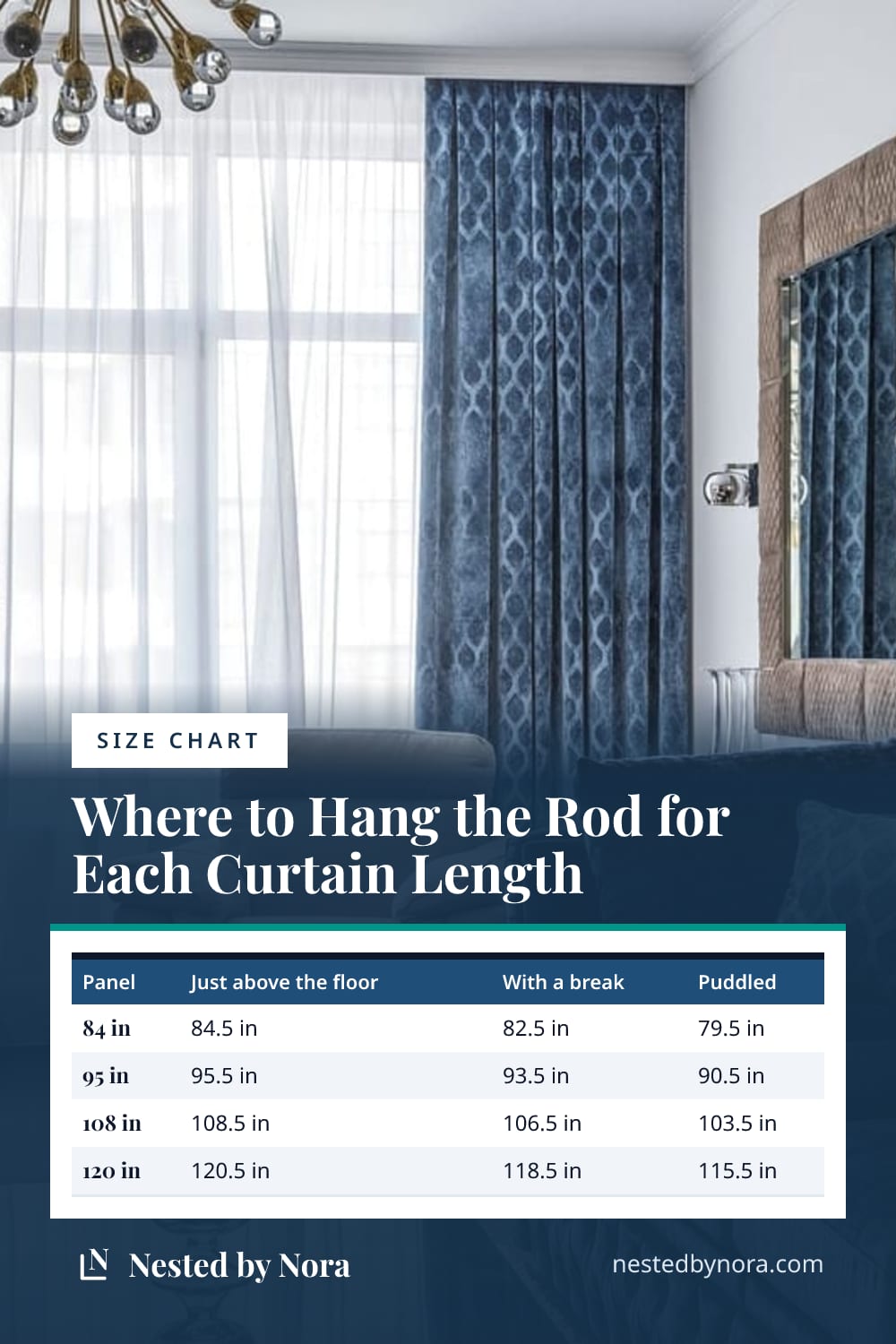
Save it for later
Pin this page so it's handy when you're ready to buy.
Save to Pinterest (opens in a new tab)